

Wondering if sheep milk has lactose? Seeking a dairy source that your stomach will agree with? It is a worthy search that we are ready to support! Read on for up-to-date answers to this question.
Let’s get into it!

The Basics: Sheep Milk and Lactose Content
Are you or someone you love living with lactose intolerance? This is when the body lacks the enzyme, lactase, to break down lactose in the digestive system, allowing you to enjoy dairy products from start to finish. Ice cream, cheese, milk, you-name-it: if your body can’t digest it, it will suffer as a result. And now, you find yourself looking for dairy alternatives…like sheep milk. 🙂
Well, does sheep milk contain lactose? The short answer is, yes, it does, but before you move along, let’s clarify something. Sheep milk lactose is not nearly as harmful to most people compared to cow milk lactose!
Why? Studies have shown that there are positive effects on the digestive system thanks to the A2 proteins found in sheep milk. Keep reading to find out more and learn the potential benefits for your digestive system that come from drinking sheep milk.
Can You Drink Sheep Milk if You Are Lactose Intolerant?
Maybe. If you have been diagnosed with lactose intolerance, then sheep milk will most likely affect your digestive system in a negative way since sheep milk does contain lactose and is very similar to other milk forms. However, if you have mild lactose intolerance, you may be safe to drink sheep milk in small amounts. Just be sure to monitor carefully for symptoms.
If you have not been diagnosed with lactose intolerance, but your body reacts negatively to the A1 beta-casein in cow milk, then your body will most likely be able to tolerate and enjoy sheep milk since it doesn’t contain any of the A1 beta-casein.
Why Do We Not Drink Sheep Milk More Commonly?
So if sheep milk doesn’t contain the A1 beta-casein and therefore eliminates some of the discomfort that comes with drinking cow milk (containing A1), why don’t people who are not lactose intolerant (and react to cow milk) choose sheep milk more commonly? Why isn’t sheep milk more widely available and accessible for consumption?
Good question! There are a few reasons that we will continue to unpack below:
Less Availability
One of the reasons why people don’t use sheep milk as commonly is that it simply isn’t as readily available as cow milk. As you might imagine, compared to a cow, a sheep produces a much lower amount of milk per day, making it impossible to keep up with entire communities of milk-lovers. Think about it. When you go to major grocery stores such as Aldi or Lidl, do you normally see sheep milk beside the cow milk? Probably not. Since the availability is low, the number of people drinking sheep milk is also low.
High Production Costs
Sheep milk is not easily accessible to everyone since the prices are higher than cow milk. This is because milking sheep involves more labor, driving up the cost of the milk. Because there is less sheep milk available, the price per gallon is higher.
Usually Used for Cheese Instead of Milk
Since sheep milk is normally used for cheese instead of milk, this means there is less sheep milk available to drink. Sheep milk includes a higher amount of protein and fats compared to other milk sources, giving it a quality texture for cheese making. Some popular cheeses like feta, ricotta salata and manchego are made from sheep milk.
Cultural Influences
Around 1850, farmers in the United States came to realize that the money was not found in sheep, but in dairy cows, which produced milk that could be used to make butter, cheese, or simply for drinking. As a result, many farmers switched to raising cows for dairy, which has influenced the availability of sheep milk in the United States today.
Seasonal Shortages
On top of all the other reasons we’ve listed, sheep milk tends to be consumed less because sheep can’t naturally produce milk year-round. When lambs are weaned or days become shorter in winter, milk production stops. In fact, sheep usually only produce milk for six months out of the year. Farmers can breed sheep to give birth during different seasons through controlled internal drug release, which is one option that can cause milk to be available on the off season.

How Much Lactose is in Sheep Milk?
There is approximately 4.9% lactose content in sheep milk.
Is Sheep Milk Easy on the Stomach?
Sheep milk is shown to be easier on the stomach for those who have not been diagnosed with lactose intolerance but find that cow milk is not tolerated by their stomach. Why is this the case?
Most cow milk sold includes the A1 beta casein, which can be a root of digestive discomfort in humans. Thankfully, since sheep milk contains the A2 beta casein, it is easier to digest and alleviates discomfort.
For example, a study performed on children with dairy sensitivities (published by the Journal of Pediatric Gastroenterology and Nutrition) revealed that when they switched to milk with only the A2 casein, they reported fewer gastrointestinal symptoms, including improved stool consistency and reduced stool frequency.
In addition, the smaller fat globules of sheep milk make it easier to digest and consume.
However, this is not a one-size-fits-all situation. Sheep milk is indeed easier on the stomach, compared to milk with the A1 beta casein. But, it remains that if someone is lactose intolerant, sheep milk will probably aggravate their stomach.
Is Sheep Milk as Inflammatory as Cow Milk?
No. Because sheep milk contains the A2 beta casein, it alleviates a lot of the inflammatory issues that bother people with dairy sensitivities to cow milk with the A1 beta casein.
Why can the presence or absence of A1 beta casein make such a difference? Good question. At position 67 of a protein chain, there is one difference between A1 and A2 that affects our bodies. For A1, in that certain position, histidine resides, which then releases BCM-7, often damaging intestinal-barrier integrity. Studies published by Applied Sciences have shown that this can negatively affect irritable bowel syndrome and exacerbate lactose intolerance symptoms. The A2 protein does not include histidine.
Milk that contains the A2 beta casein (as does sheep milk), is supported by research published in Applied Sciences to be beneficial for gastrointestinal function and possibly increase microbial activity.
It must be noted that although sheep milk is less inflammatory than cow milk with the A1 beta casein, one can also get cow milk with A2 that is less inflammatory.
Lactose in Sheep Milk vs Cow Milk
If you want a comparison of the lactose amounts in sheep milk versus cow milk, take a look at the follow graph:
| Type of milk | Amount of lactose by mass |
| Sheep milk | 4.9%* |
| Cow milk | 4.8%* |
From the table, one can see that sheep milk contains slightly more lactose than cow milk. However, sheep milk can often be tolerated in people without dairy sensitivities better than cow milk due to the A2 protein found in sheep milk.
But for people with diagnosed lactose intolerance, sheep milk will likely not be tolerated.
*All numbers are approximate

Lactose in Sheep Milk vs Goat Milk
Overall, goat milk contains less lactose than sheep milk. To see a breakdown in numbers, view our graph below:
| Type of milk | Amount of lactose by mass |
| Sheep milk | 4.9%* |
| Goat milk | 4.4%* |
*All numbers are approximate
Which Animal Has The Least Lactose?
If you are looking for animal milk with the least amount of lactose, goat milk is the option for you.
Conclusion
Is your mind spinning with all the new information you’ve just received? Let’s summarize it quickly for you:
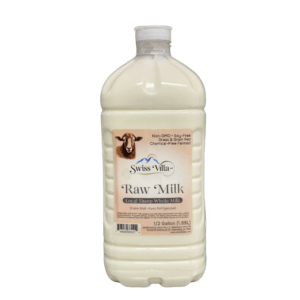
Here at Swiss Villa, we are proud to offer raw sheep milk that is soy-free and GMO-free, raised on chemical-free, small Amish farms in Lancaster County. If you crave the delicious texture of sheep cheese, check out our different options, including raw cheddar, raw feta, and raw gouda.